
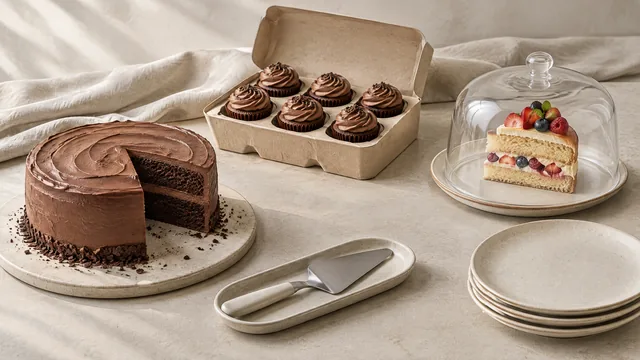
Separate the serving format from the flavour
Start with what each guest will receive: an individual cake, a slice cut at the venue, or a slice prepared beforehand. Next decide what goes into that portion. A chocolate cupcake and a slice of chocolate cake can suit different serving arrangements even if their flavour direction is similar. Likewise, a fruit-topped sponge and a dried-fruit loaf should not be treated as interchangeable because both are called fruit cake.
Use the table to shortlist formats, not to assume a bakery offers every combination. Its practical trade-offs depend on the agreed size, recipe and finish. At a seated lunch, plates and a server may already be available; at a standing gathering, an easy-looking dessert still needs a clean way to handle it.
| Possible format | Portion unit | Main serving advantage | What to check |
|---|---|---|---|
| Cupcakes | Individual piece | No shared cake cutting | Piece size, liner removal and topping clearance in packaging |
| Whole chocolate cake | Agreed slice | An intact centrepiece before serving | Cutting guide, filling and who provides plates and utensils |
| Prepared chocolate slices | Prepared portion | Less cutting work during service | Whether offered, portion consistency and protection for cut faces |
| Whole fresh-fruit-topped cake | Slice with topping | Fruit forms part of the shared presentation | Fruit distribution, topping stability and recipe-specific storage |
| Dried-fruit loaf, if intended | Loaf slice | A different fruit-cake style to compare | Actual recipe, slice thickness and any alcohol or nuts |
Cupcakes: count pieces, but plan how they will be eaten
Individual pieces remove the need to divide a larger cake, but they do not automatically remove the need for plates. A tall frosting swirl can be awkward to bite while holding a drink. A filled cupcake may be easier to eat with a fork. Ask for the intended piece size and finished height before deciding whether guests can comfortably eat standing up.
For visual references, explore the Cupcake page, then ask which individual presentation and packaging options can be confirmed for your occasion. The category name alone does not establish the dimensions or available flavours. [S1]
Treat a regular cupcake and a mini cupcake as different portion units. If guests can choose between flavours, record the requested quantities separately rather than ordering an undifferentiated total. For take-home pieces, ask whether packaging keeps the topping clear of the lid; a paper liner is not a protective box.
Chocolate cake: decide when the whole cake becomes slices
A whole chocolate cake suits an occasion where the intact cake matters before dessert. However, the cutting step needs a stable working surface, suitable utensils and an assigned person. If the venue cannot provide those, ask whether prepared portions are possible instead. Do not assume pre-cutting is included in a cake quotation.
Use the Chocolate Cake page as a starting point for comparing presentation, then request details of the proposed sponge, filling and finish. The page identifies the category; it does not give a universal serving yield or storage rule. [S2]
A soft layered recipe and a firmer recipe may need different handling. Ask how the proposed cake should be portioned and whether decorative elements obstruct the cut lines. If a message or central decoration must remain intact for a photograph, plan that moment before cutting rather than trying to reconstruct the display afterwards.
Fruit cake: clarify the recipe and the topping distribution
Write out what you mean by fruit cake: fresh fruit on a cream cake, fruit in the filling, or dried fruit baked into the cake. This prevents a familiar name from standing in for a recipe. Ask about any alcohol, nuts or prepared fruit ingredients where these affect the guests' requirements.
The Fruit Cake page is a resource for beginning a fruit-themed cake enquiry. Confirm the actual fruit preparation and cake construction rather than inferring them from the category heading. [S3]
For a fruit-topped whole cake, consider what each slice will look like. A large arrangement concentrated in the centre may not divide as evenly as toppings placed with portions in mind. Ask the baker whether fruit can be distributed to suit the cutting plan. Fruit decoration is not evidence that a cake is dairy-free, gluten-free or suitable for a particular allergy.
Compare quotations using the same portion brief
Give each option the same brief: actual cake eaters, whether cake is the main dessert, intended portion size and service setting. Compare individual piece counts with an agreed sliced yield, not with diameter alone. A small tasting slice is different from a full dessert portion, and a visually large cake may include decoration that is not served.
When design affects the decision, explore the Custom Cake page and ask whether your preferred appearance can work with the serving format. Describe the needed outcome, such as easy slicing or protected individual portions, rather than assuming a reference design can be reproduced unchanged.
Request itemised scope covering the cake, portion preparation, packaging and any transport arrangements. Ask separately about boards, boxes, plates, forks and cutting equipment. Then compare confirmed totals for equivalent portions. A lower headline amount is not necessarily the simpler option if the venue must supply additional equipment or labour.
Receive, store and serve the chosen format
Nominate someone to receive the order and check it before display. Match the piece count or cake specification to the confirmation, inspect packaging and look for shifted toppings or damage. Keep different flavours identifiable using the accompanying information, rather than guessing from frosting colour.
Hong Kong's Centre for Food Safety advises choosing safe raw materials, keeping hands and utensils clean, separating raw and cooked food, cooking thoroughly and keeping food at safe temperatures. These are handling principles, not certification of a supplier. [S4]
Ask for written storage and serving instructions for the actual filling and topping. Confirm that the packaged cake fits the available storage space. Keep food protected until needed, and agree with the venue how portions will be brought out. Neither chocolate decoration nor individual packaging establishes that a cake can stay unrefrigerated throughout an event.
A ready-to-send serving-format enquiry
Send a brief like this: “We are comparing individual cupcakes with a whole or prepared-slice cake for [occasion] on [date]. There will be [number] cake eaters, eating [seated/standing], and cake will be [the main dessert/a tasting alongside another dessert]. We prefer [chocolate/describe the fruit style]. Please confirm the portion size or sliced yield, proposed ingredients, packaging dimensions, storage instructions and itemised quotation.”
Add any dietary requirement explicitly, including questions about cross-contact. Finish with: “Please state whether portion preparation, cutting equipment and transport are included. Our receiving person is [name or role], and the venue can provide [equipment and storage].” This gives the bakery a serving problem to answer, not just a flavour name.
Questions you may be asking
Can I replace one cake slice with one cupcake when comparing quantities?
Only after comparing the intended sizes. One cupcake is a counted piece, but it may not equal the agreed slice in amount or eating experience. Ask the bakery to describe both portions against your dessert brief.
Does fruit cake always mean a cake topped with fresh fruit?
No. Specify whether you want fresh fruit, a fruit filling or a dried-fruit cake. Confirm the recipe, including any alcohol or nuts relevant to the guests, before comparing serving and storage needs.
Should I request pre-cut slices if I still want an intact cake photograph?
Explain both priorities. Ask whether the proposed cake can remain intact until the photograph and then be cut at the venue, or whether prepared slices can be presented acceptably. Pre-cutting arrangements need confirmation rather than assumption.
What happens to decorative toppers when a whole cake is served?
Ask which components are edible and which must be removed, including any supports. Assign someone to remove non-food decorations before cutting. Do not include decorative height or unserved elements when judging the dessert portion.
Are cupcakes a good choice when no forks are available?
They can be, depending on size, filling and topping. Ask whether the proposed piece is comfortable to eat from its liner. If it needs a plate and fork, arrange those rather than relying on the individual format alone.