
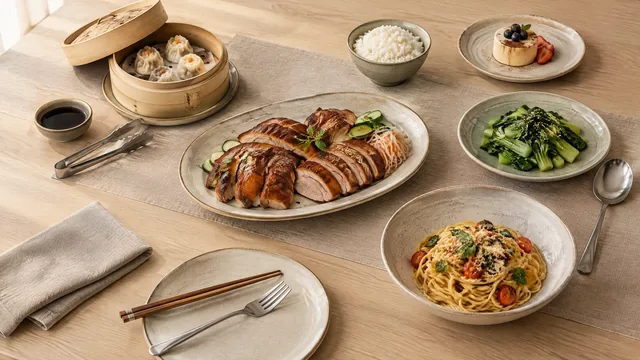
Choose how guests will eat before choosing dishes
Start with seats and table space. A seated meal can accommodate dishes that need cutting, small bowls and shared sauces. A standing reception needs food guests can manage with the available plate and utensil; a large sauced main may work at a dining table but be awkward beside a drinks station. Record whether everyone eats together or arrives gradually, because that changes replenishment and reserve storage.
YumYum's Chinese page describes dim sum, roast meats and banquet-style dishes. [S1] Explore Chinese Food Catering as a starting point for the communal part of the menu, then ask which dishes suit your actual format. If you choose shared rice and a Chinese main, give the Western additions another purpose rather than ordering a second full dinner.
Make the two cuisines complement rather than compete
Build around contrast in texture, sauce and richness, not a rigid half-Chinese, half-Western split. For example, a steamed vegetable dish could accompany a roast main, while a crisp starter could precede a softer main course. These are planning combinations, not a confirmed supplier menu. Avoid making every savoury choice fried, heavily sauced or difficult to portion.
The provider's Western page lists pasta, roast dishes and accompanying sides. [S2] Use Western Catering to compare that side of the meal, especially whether a dish is intended as a main or an accompaniment. Pasta alongside rice can offer choice, but both should share the starch allowance. Two full starch allocations can crowd out vegetables and leave little appetite for the dishes guests came to share.
Use a dish-role table to find duplication
Write the proposed menu in roles before requesting quantities. The examples below are adaptable combinations, not product specifications. A platter name or tray size is not a serving count: ask what usable portions it contains and whether the stated servings assume a full meal or a tasting portion.
| Meal role | Possible combination | Quantity basis to confirm | Decision check |
|---|---|---|---|
| Starter | Dim sum before a shared roast main | Pieces per selection | Keep it a starter, not another lunch |
| Main | Chinese roast meat with a Western vegetable side | Edible portions; cutting arrangement | Avoid a second main with the same job |
| Starch | Rice with an optional pasta portion | Combined side servings | Divide one allowance between choices |
| Vegetables | Cooked greens or a separate salad | Side portions and holding needs | Give non-meat dishes proper space |
| Dessert | One shared sweet course | Individual pieces or cut portions | Check whether a cake is already planned |
Give dim sum a defined place in the meal
A dim sum opening can introduce the Chinese side without requiring another set of banquet mains. Set a piece allowance for each starter selection and note whether guests will also eat buns, rice or pasta later. Count individual pieces separately from main-course portions; neither a basket nor a photograph tells you how many guests a selection will satisfy.
Explore Dim Sum Catering when comparing a short starter round with a more substantial yum cha-style meal. Ask about the actual pieces, fillings and suitable holding arrangements. If speeches separate the starter from dinner, plan storage for the waiting courses rather than putting everything on the table at once.
Let a roast centrepiece replace, not multiply, mains
A whole roast presentation changes more than the appearance of the table: it also needs a cutting plan, serving space and a clear place in the portion calculation. YumYum's roast pig page presents whole suckling pig as an option for shared occasions. [S3] Explore Roast Pig Catering if a centrepiece suits your gathering, without assuming its size or edible yield.
Ask whether it arrives whole or portioned, who will cut it, and what equipment is included. If it becomes the main meat course, reduce overlapping roast or pork dishes. If it is mainly for presentation, confirm how and when it will enter dinner service; a display item should not silently count as everyone's main meal.
Arrange service around each dish's needs
You do not need separate Chinese and Western tables simply because the cuisine names differ. Arrange dishes by service needs: accessible plates, separate serving tools, space for hot dishes and a distinct place for cold items. Check the venue's power supply and equipment restrictions before choosing foods that depend on particular holding equipment. Keep the centrepiece from blocking access to side dishes.
Hong Kong's Centre for Food Safety recommends clean hands and utensils, separation of raw and cooked food, thorough cooking and safe holding temperatures. [S4] Agree who receives the food, checks containers and instructions, and monitors service. A warm-looking tray is not evidence that a dish is being held safely.
Collect dietary requirements before finalising the menu. Ask separately about ingredients, sauces and cross-contact controls; a vegetable dish is not automatically suitable for every vegetarian or allergy requirement. Give each dish its own serving utensil and ask the provider how any specially requested meal should be identified and kept separate.
Send one menu enquiry with measurable quantities
Give the provider one consolidated brief, even if guests have different cuisine preferences. Request itemised quantities in meaningful units and an explanation of any substitutions. Confirm charges for equipment, cutting, staffing, transport and collection separately from food; do not assume a menu package includes them.
A ready-to-send enquiry: ‘We are planning a seated shared meal on [date] at [venue] for [confirmed diners], with service beginning at [time]. We want a dim sum starter, one principal main, a vegetable side, shared starch choices and one dessert. Please suggest a coherent Chinese–Western combination and quote piece counts, main portions and side servings. Our dietary requirements are [details]. Please confirm ingredients and cross-contact arrangements, delivery scope, suitable holding equipment, cutting duties and any additional charges.’
Before confirming, name one receiver and one service lead. At arrival, compare the dishes and counts with the order, check the dietary meal identification and locate the serving tools. Resolve missing items or unsuitable holding arrangements before starting service.
Questions you may be asking
Does a mixed menu need equal numbers of Chinese and Western dishes?
No. Balance the meal by role and guest preference. A Chinese main with Western sides can be coherent without an equal dish count.
How should I compare a set menu with separate platters?
Ask for the actual contents and portion basis of both. Compare starter pieces, main servings and side servings, not just the number of trays or the package's headline guest count.
Can I offer both rice and pasta without ordering too much?
Yes, as a planning choice: tell the provider they are alternative starch sides within the same meal. Request a split quantity rather than two full-meal allocations.
What if some guests do not eat pork?
Plan a substantial alternative main and ask about sauces, preparation and serving separation. Do not assume vegetables or dim sum are pork-free without ingredient confirmation.
Is one buffet line suitable if guests arrive at different times?
It may be, if there is an agreed holding and replenishment plan. Record the arrival pattern and appoint someone to manage reserve dishes; do not leave the whole order out simply for convenience.