
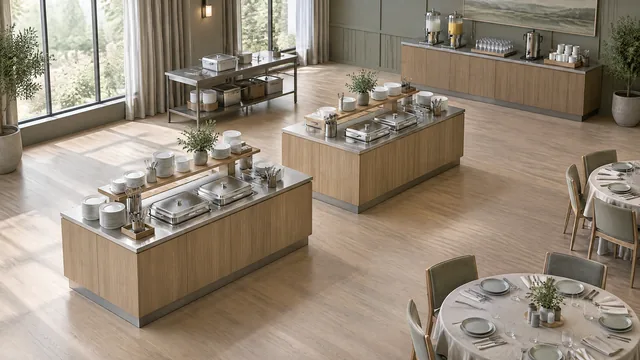
Start with the busiest moment, not the invitation list
An office lunch released after one presentation creates a different demand pattern from a reception where guests arrive throughout the evening. Put the programme beside the floor plan. Mark when registration ends, speeches finish and food becomes available. If everyone is released together, assess the layout for that surge rather than average attendance.
Count everyone who will eat, including organisers or performers where relevant, but record them separately from the guest list. Confirm whether the menu is a complete meal or refreshments between meals. A package name alone does not tell you the number of portions of each dish, the tray sizes or how quickly guests can collect them. Request those details in usable units.
For fifty guests, make one route easy to follow
A single serving line is worth considering when the room has enough circulation space and the menu is straightforward to portion. Place plates at the entrance, then arrange dishes in an order that avoids reaching back across other guests. Put cutlery and napkins at the end where practical, so people do not juggle them while serving themselves.
Use the 50 Person Catering Package as a starting point for a group-sized menu enquiry, then ask how the proposed dishes would fit your actual tables. The provider describes a fifty-person catering option; the serving arrangement and inclusions for your event still need confirmation. [S1]
Draw the exit as carefully as the entrance. It should lead towards dining space without crossing the queue. Guests returning for another helping should not have to push past arriving guests or the person carrying replacement trays.
For a hundred guests, add access before adding tables
With a larger crowd, another table helps only if it creates another usable route. Two tables against the same narrow wall may still funnel everyone through one entrance. Consider serving from both sides of an island, separate food stations, or controlled release by seating area. Each requires sufficient room and clear instructions.
When comparing the 100 Person Catering Package, request a proposed layout alongside the menu and portions. The page describes catering for a hundred-person group, but does not establish the floor space or service capacity of your venue. Ask which equipment and onsite duties the quotation covers. [S2]
If stations carry different dishes, guests may need to visit both. Plan that movement explicitly rather than treating the queues as interchangeable. If either station can provide the complete meal, communicate that clearly and allocate food reserves so one side does not empty while the other remains stocked.
Match the layout to the menu and the room
The slowest serving task deserves attention. A dish requiring several separate additions may hold up a line more than a tray of easy-to-lift portions. Move optional sauces out of the main collection path where feasible. Give drinks and desserts their own space if guests will collect them at a different point in the programme.
Explore Buffet Catering when comparing self-service formats, but assess the proposed menu against the room. Ask whether dishes need staff portioning, which serving utensils are supplied and whether replacement pans are compatible with the planned equipment.
| Layout | Useful when | Check before choosing |
|---|---|---|
| One-direction serving line | Arrivals are spread out and dishes are easy to collect | Queue space, an unobstructed exit and refill access |
| Island served from both sides | The room offers clear circulation around a central table | Reach, suitable equipment and utensils on both sides |
| Separate food stations | Different dishes need different serving methods | Whether guests need every station and how routes cross |
| Release by seating area | A programme brings everyone to the meal together | A host to explain the sequence and assistance for guests who need it |
Keep replenishment out of the guest route
Reserve a working area for unopened trays, clean utensils and equipment, separate from used crockery. Agree how food will be held before service and who will authorise each replacement. The Centre for Food Safety recommends cleanliness, separation of raw and cooked food, thorough cooking and safe temperatures; an attractive buffet layout does not replace these controls. [S4]
At handover, match the delivered dishes and quantities to the order. Check that the agreed holding equipment and serving utensils are present, and obtain dish-specific handling instructions. Avoid placing every tray out simply to make the table look full. Arrange staged replenishment under suitable holding conditions, with withdrawal instructions agreed before guests arrive.
Dietary meals need an identifiable handover process rather than a vague corner of the buffet. Confirm ingredients and cross-contact questions with the caterer, designate the responsible person, and keep the relevant utensils separate. A vegetarian label is not an assurance about allergens.
Assign duties before deciding the staffing requirement
List the jobs that happen simultaneously: receiving delivery, guiding guests, checking trays, replenishing food and clearing used plates. A host speaking on stage cannot also monitor the buffet. Give each task an owner and a backup, with a named lead able to resolve missing items or changes to the programme.
The Catering Staff Hire page is a resource for exploring event service support. [S3] Send a duty list rather than requesting an unspecified number of helpers. Confirm whether the proposed staff handle setup, food service, drinks, clearing and equipment collection, and what their agreed start and finish cover.
Keep clearing separate from clean service. Locate the return point away from plates and food, and check the venue's waste arrangements. Allow guests who need seated eating or assistance to reach food without negotiating a crowded queue.
Send an enquiry that connects the menu to the floor plan
A useful enquiry can read: “We are planning a meal for [headcount] at [venue], with guests expected to eat after [programme point]. Attached is the room plan showing doors, available tables and seating. Please propose a serving route and confirm portions by dish, tray dimensions, holding equipment, dietary-meal arrangements and staff duties. Please itemise food, equipment, staffing and delivery charges.”
Add access details such as the goods lift, loading permission and route from unloading to the room. Request a handover window, setup responsibilities and equipment collection arrangements; delivery arrival is not automatically service readiness. Before opening the buffet, the event lead should check the guest route, clean utensils, dietary handovers and reserve-food arrangements against the agreed plan.
Questions you may be asking
Does a hundred-person event always need two buffet lines?
No. Arrival pattern, menu complexity and room access matter more than headcount alone. Assess whether another line creates a genuine additional route, and confirm space and equipment before committing.
Should drinks come before or after the food queue?
A separate drinks point is often easier to manage. Guests can collect drinks without blocking food collection, provided the route leaves room to carry both safely and there are surfaces nearby.
What if a speech delays the planned meal opening?
Tell the catering lead promptly. Follow the agreed holding instructions rather than opening trays to wait on the table, and adjust the service sequence with the venue and caterer.
Can organisers refill trays without hired waitstaff?
Only assign this to a named person who understands the agreed handling instructions and equipment. Check that their other duties do not leave replenishment unattended during the busiest period.
How can wheelchair users avoid a difficult serving route?
Check access with the venue and relevant guests before finalising the plan. Provide clear circulation, suitable dining space and an agreed assistance option without assuming everyone wants help.